

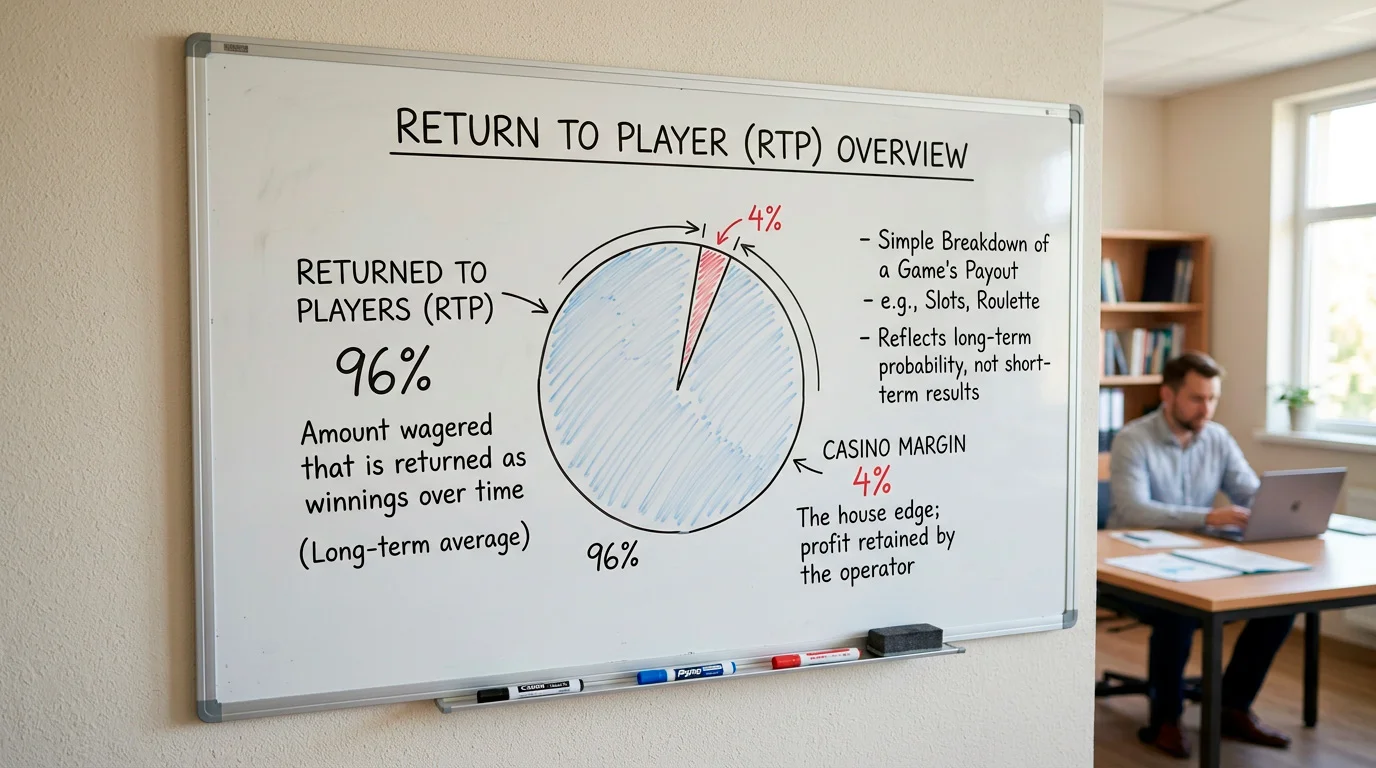
Return to player is the most cited, most misunderstood, and most misused number in online gambling. I have watched players obsess over a 0.3% difference in RTP while ignoring game features that affect their actual results far more — session volatility, bet sizing relative to bankroll, and the length of time they spend playing. RTP is a starting point for understanding how a casino game works, but treating it as the finish line is one of the most common mistakes in how people evaluate their gaming choices. UK online casino GGY hit £1.55 billion in Q1 2026, and the players contributing to that figure were overwhelmingly playing games whose RTP they either did not check or did not understand in context.
Where the highest returns sit: high RTP slots.
What RTP Actually Measures
A few years back, I ran a simple exercise with a group of recreational players. I asked each of them what RTP meant. Every single one said something along the lines of “the percentage of my money the game gives back.” That answer is close enough to be useful — and wrong enough to be dangerous.
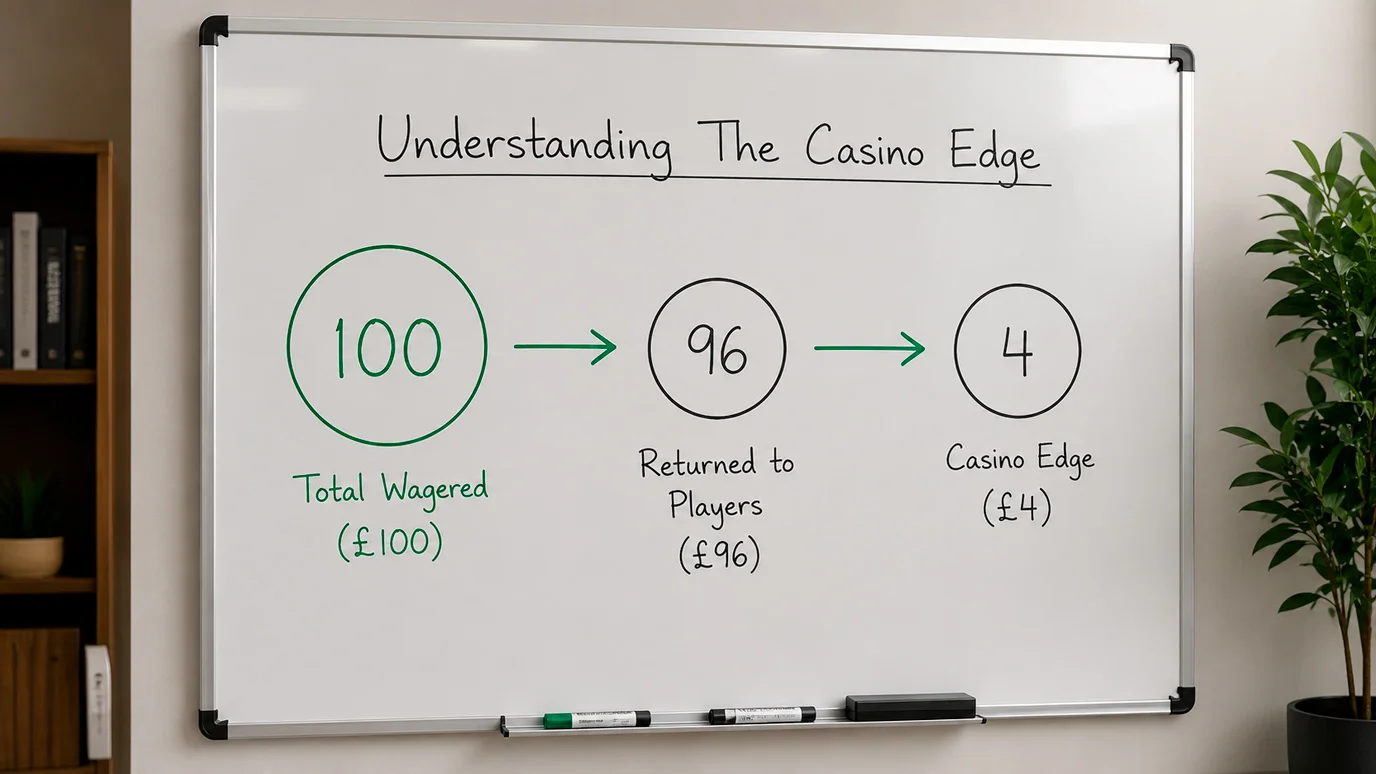
RTP — return to player — is a theoretical statistical measure calculated over millions of simulated game rounds. When a slot is labelled 96.5% RTP, it means that across an infinite number of spins at the same bet level, the game will return 96.5 pence of every pound wagered. The remaining 3.5 pence is the house edge — the operator’s gross margin before tax, platform costs, and licensing fees.
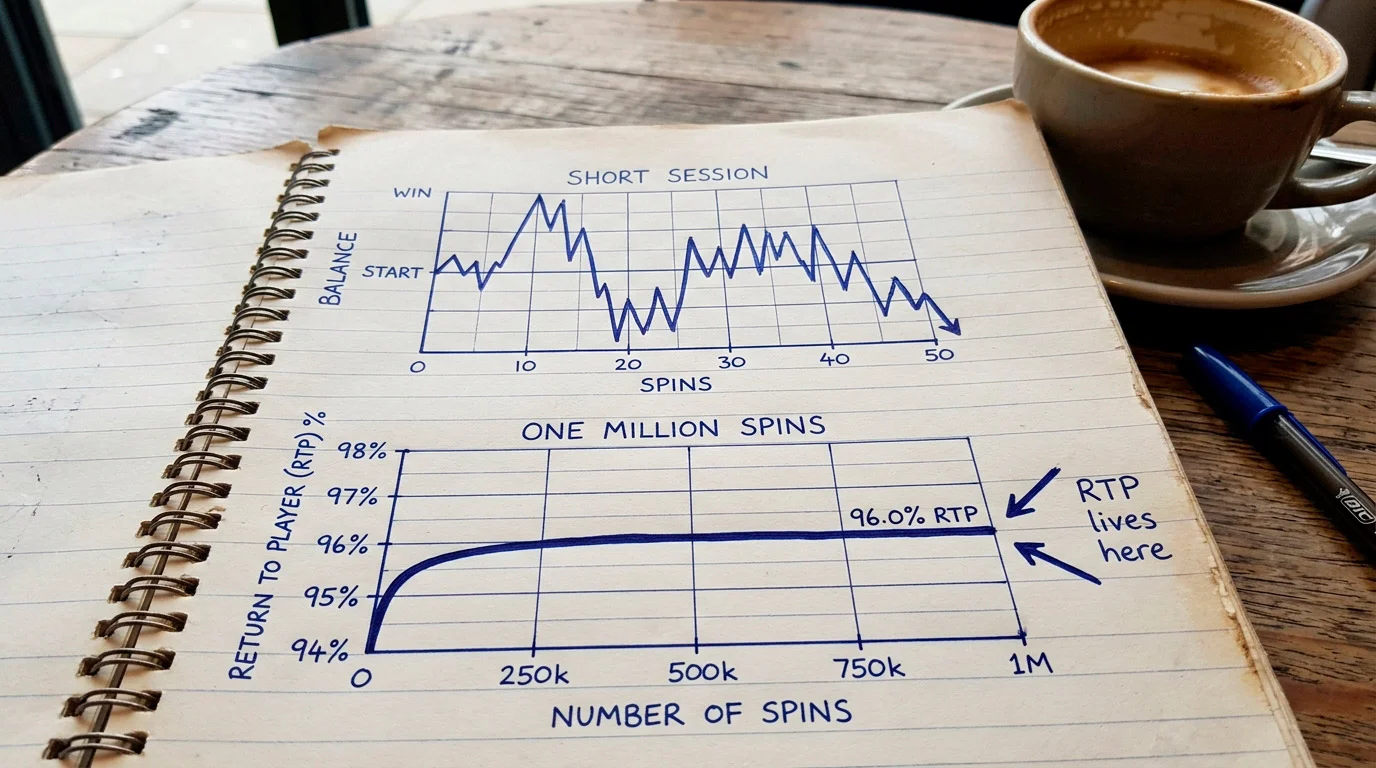
The critical word is “theoretical.” No individual player experiences infinite spins. In a session of 200 spins, your actual return can be 0% (total loss), 300% (a lucky streak), or anything in between. RTP describes the game’s long-run mathematical behaviour, not what happens to your bankroll on a Tuesday evening. The confusion between theoretical aggregate returns and actual individual session outcomes is where most misunderstanding lives.
UKGC licence conditions require operators to publish the RTP of every game they offer. This information must be accessible before play and, in many implementations, is displayed within the game’s information screen. The requirement exists so players can make informed comparisons — but informed comparison requires understanding what the number does and does not tell you.
RTP Across Game Categories: Where the Numbers Sit
Not all casino games are built on the same mathematics, and RTP varies significantly by category. Here is where the main formats typically land.
Online slots range from roughly 88% to 99% RTP, with the bulk of titles clustering between 94% and 97%. The average across UK-licensed online slots sits around 96%. Slots with RTP below 94% exist but are increasingly uncommon on UKGC-licensed platforms, partly because player awareness has risen and partly because lower-RTP titles attract regulatory scrutiny around fairness expectations. Slots above 97% RTP are marketed as “high RTP” — a distinction covered in more depth in the high-RTP slot analysis.
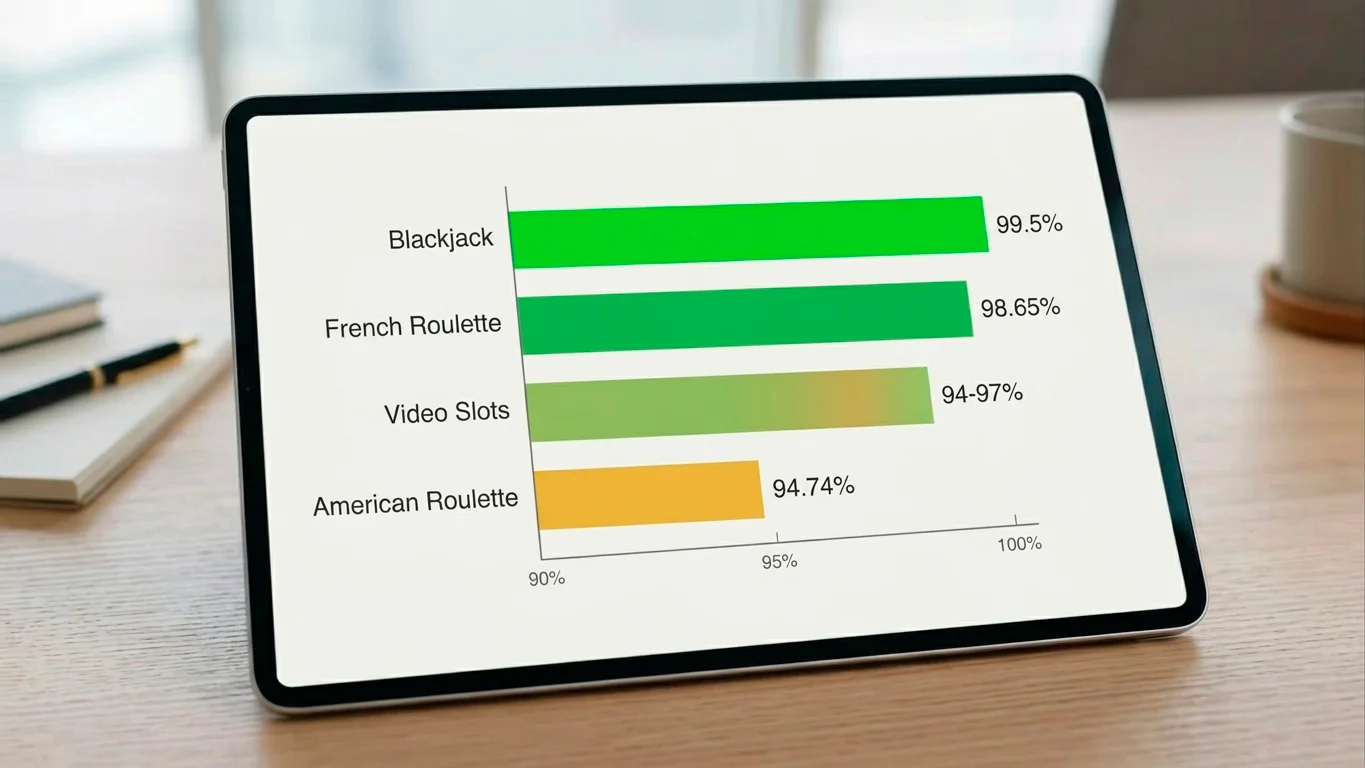
Blackjack typically offers RTP between 99.0% and 99.7%, depending on the rule variant. A standard eight-deck blackjack game with dealer standing on soft 17 and doubling allowed on any two cards sits around 99.5% RTP when played with perfect basic strategy. The operative phrase is “perfect basic strategy” — the RTP figure assumes the player makes the mathematically optimal decision on every hand. Deviations from basic strategy lower the effective RTP, sometimes significantly.
European roulette — a single-zero wheel — has a fixed RTP of 97.3% across all bet types (with the exception of the five-number bet in American roulette, which is why you should never play the American variant if a European one is available). The house edge of 2.7% applies whether you bet on red, on a single number, or on a column. The RTP is identical; the variance is different. A bet on red returns close to 1:1 frequently, while a bet on a single number returns 35:1 rarely. Same RTP, entirely different session experience.

Live dealer games carry the same RTP as their RNG equivalents — the maths does not change because a human dealer is present rather than software. Evolution Gaming, which holds 73.4% of the global live dealer market, publishes RTPs for each of its titles. Game shows like Crazy Time or Lightning Roulette have RTPs in the 95-96% range, lower than standard table games but higher than many slot titles.
The full picture is in our guide to UK real-money online casinos.
Variance: The Number RTP Doesn’t Show You
I tracked my own session results across 50 blackjack sessions and 50 slot sessions, each with the same starting bankroll and the same duration. The blackjack sessions, on a game with 99.5% RTP, produced results clustered tightly around -0.5% to -2% per session. The slot sessions, on a game with 96% RTP, produced results ranging from -100% (total loss) to +400% (one particularly fortunate run). The game with the lower RTP delivered the bigger wins and the bigger losses. The game with the higher RTP delivered consistent, small losses.
That difference is variance — sometimes called volatility. It measures how widely individual outcomes scatter around the expected average. High-variance games produce infrequent large wins interspersed with extended losing periods. Low-variance games produce frequent small wins with rare large payouts. RTP tells you where the centre of gravity sits; variance tells you how far from that centre any given session is likely to land.
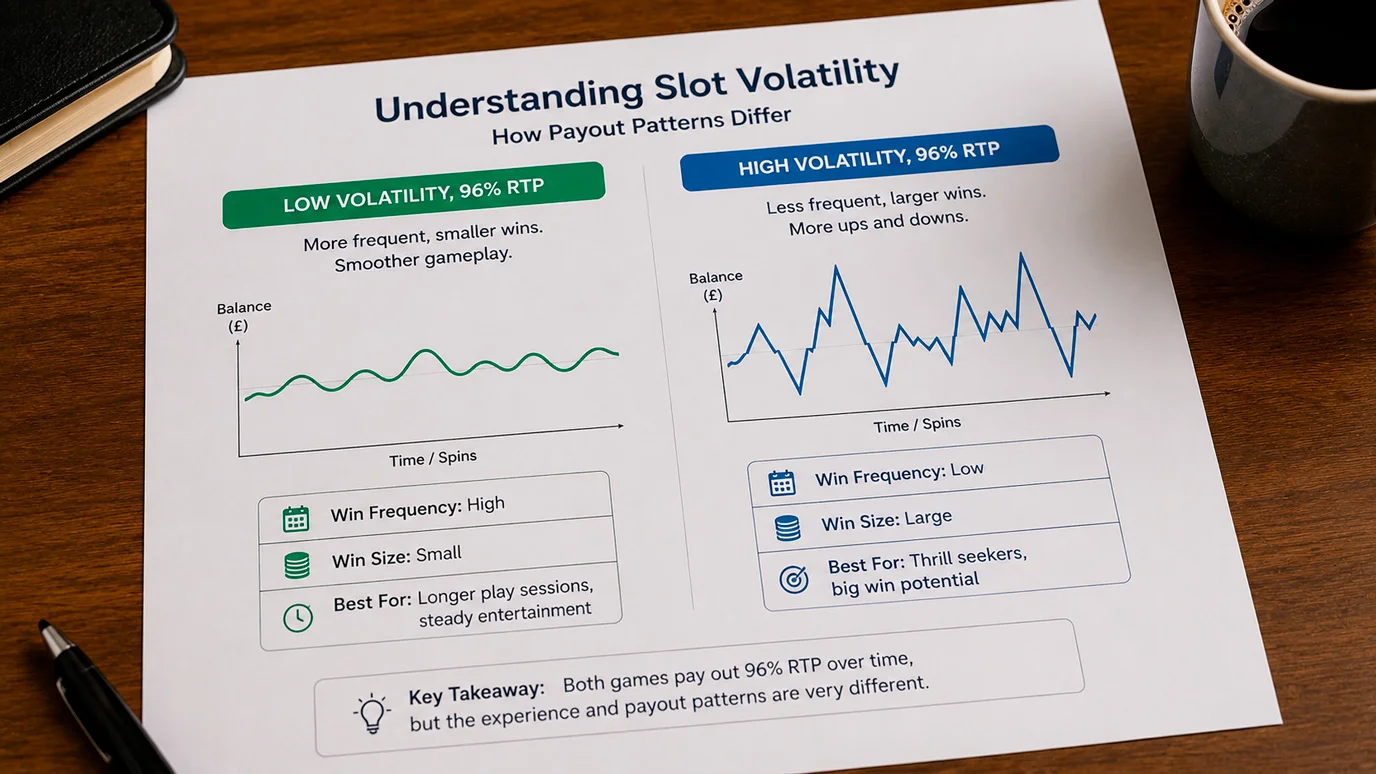
Two slots can both carry 96% RTP and deliver completely different experiences. One might pay small amounts on 40% of spins, rarely exceeding 10x the bet. Another might pay nothing on 70% of spins but occasionally deliver 500x or 1000x wins. The player who selects a game based on RTP alone, without considering variance, has no idea what kind of session to expect. Game providers classify variance as low, medium, or high, though the definitions are not standardised and the labels are more descriptive than mathematical.
Why a Small RTP Difference Matters Less Than Session Length
Consider two slots. Slot A has 96% RTP. Slot B has 94% RTP. On a single £1 bet, the expected loss on Slot A is 4p and on Slot B is 6p. The difference is 2p. Over 100 spins at £1, the expected loss is £4 on Slot A and £6 on Slot B — a £2 difference that is swallowed entirely by session variance. You would need thousands of spins for that 2% gap to emerge as a statistically measurable pattern.
What affects your actual session outcome far more is how long you play and how you size your bets relative to your bankroll. Playing a 97% RTP slot for five hours produces more expected loss than playing a 94% RTP slot for thirty minutes, because the total amount wagered — not the RTP percentage — is the primary driver of cumulative loss. A player wagering £2 per spin for 500 spins puts £1,000 through the game. At 96% RTP, the expected loss is £40. The same player wagering £2 per spin for 100 spins puts £200 through the game. At 93% RTP, the expected loss is £14. Lower RTP, shorter session, smaller loss.
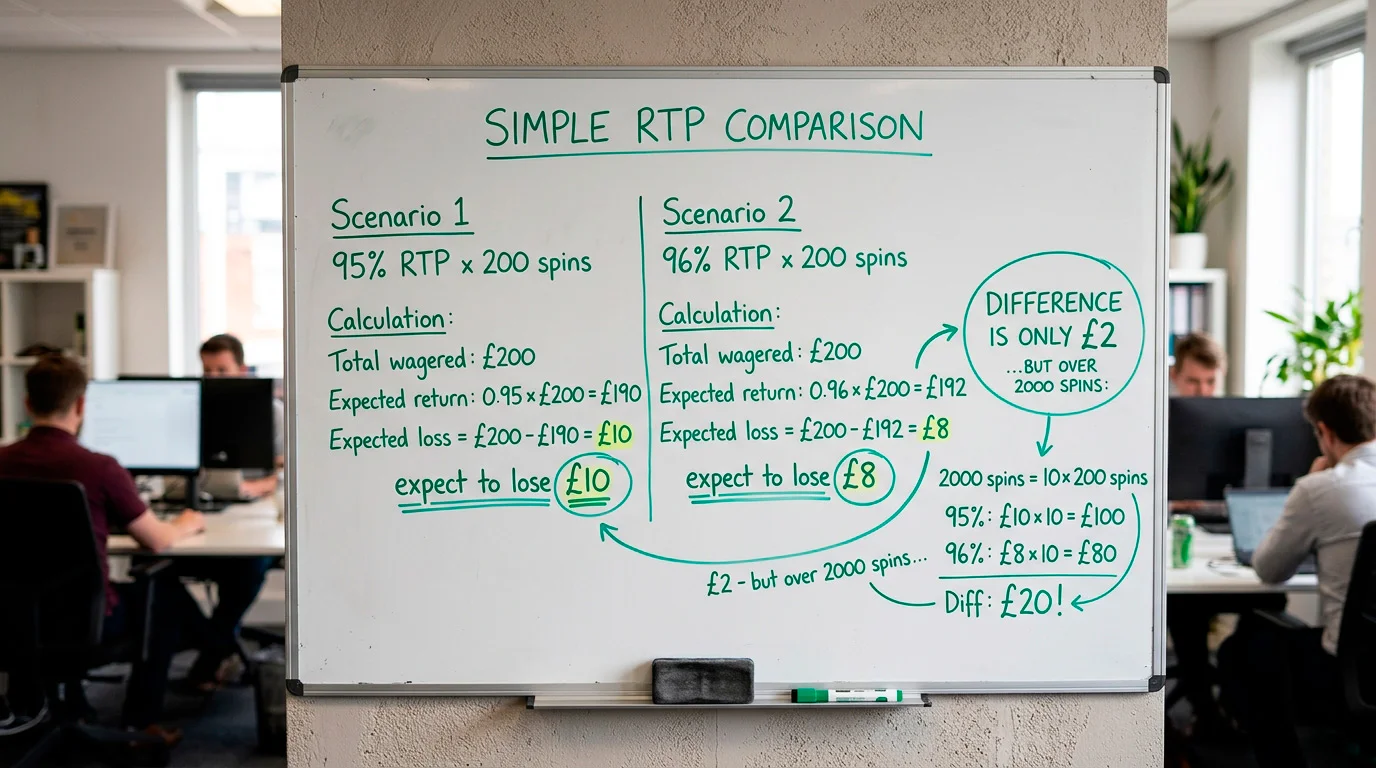
This is not an argument to ignore RTP. It is an argument to weigh it alongside session length, bet size, and volatility rather than treating it as a standalone quality metric. The player who filters exclusively for high-RTP slots and then plays for four uninterrupted hours is optimising the wrong variable.
RTP in the Context of UK Regulation
The UKGC does not mandate minimum RTP values. There is no regulatory floor below which a game’s return is considered unfair. The Commission’s position is that transparency — publishing the RTP — is sufficient, and that players can make informed choices once the information is available. This is a philosophical difference from some other jurisdictions: Denmark, for example, sets a minimum 85% RTP for online slots.
The practical consequence is that UK players encounter a wider range of RTPs than players in more prescriptive markets. The 60% of online casino revenue generated on mobile devices reflects an audience that tends to select games based on theme, features, and brand recognition rather than published RTP figures. The informed minority who actively compare RTPs do benefit from the transparency requirement, but they remain a minority — most players engage with the game, not the maths behind it.
Articles
Created by the "onlinecasinorealmoneyuk.com" editorial team.