


The first time I created an online casino account — years before I worked in the industry — I deposited £50, clicked on the first slot I saw, and lost the lot in about twelve minutes. No strategy, no understanding of how the games worked, no concept of session management. I was not unusual. Roughly 17.4 million UK adults gamble online, and a significant portion start exactly the way I did: money in, random clicks, money gone, confusion about what happened. This guide exists because I wish someone had walked me through what I now know before I touched that deposit button.
The first tool to set: deposit limits.

Choosing a UKGC-Licensed Site: The Only Starting Point
Every legal online casino operating in the UK must hold a licence from the Gambling Commission. This is non-negotiable and easy to verify — the UKGC maintains a public register on its website where you can search by operator name and confirm their licence status. If a site does not appear on that register, it is not licensed to operate in the UK, and using it means you have zero regulatory protection if anything goes wrong.
What does a licence actually guarantee? It means the operator has met minimum standards for fair gaming (games tested by approved testing houses), financial segregation (player funds held separately from operating funds, in most licence categories), responsible gambling tools (deposit limits, time-outs, self-exclusion), and complaint handling (access to alternative dispute resolution). It does not guarantee you will win, that the site’s interface will be good, or that customer support will be responsive. The licence sets a floor, not a ceiling.

For a beginner, the practical consequence is simple: stick to UKGC-licensed sites. The 48% of UK adults who participate in some form of gambling overwhelmingly do so through licensed channels, and the regulatory infrastructure exists specifically to protect the casual player who does not know the industry’s internal workings. Unregulated offshore sites offer none of these protections, and the savings they might offer in looser terms or higher stakes are not worth the trade-off in safety.
Account Setup and Verification: Expect More Than a Username
When I started reviewing operator onboarding flows for compliance work, I was struck by how often first-time players abandoned registration mid-process. The reason is usually identity verification. UKGC rules require operators to verify your age and identity before you can gamble — and in many cases, before you can even deposit. This means providing your full name, date of birth, address, and sometimes documentation like a passport or driving licence.
Electronic verification handles most checks instantly: the operator cross-references your details against credit reference agency databases. If your details match, you are verified within seconds and can proceed. If the electronic check fails — common if you have recently moved, have a thin credit file, or your name appears differently across databases — you will need to upload documents manually. A photo of your passport or driving licence, plus a recent utility bill or bank statement showing your address, is the standard requirement.

The process feels intrusive, but it serves a specific purpose. Age verification prevents under-18s from gambling online. Identity verification feeds into the broader anti-money-laundering framework and enables the operator to apply player protection tools accurately. The KYC and verification guide covers the full document checklist and common reasons for verification delays.
First Deposit: Payment Methods, Minimums, and What to Set Before You Add Funds
Before you deposit a single pound, set a deposit limit. Every UKGC-licensed site must offer daily, weekly, and monthly deposit limits. If you are new to online gambling, setting a weekly limit that you can afford to lose entirely — and I mean that literally, assume 100% loss — is the most important action you will take. A deposit limit is easier to set before you start playing than to impose on yourself once you are engaged with the games.
Payment methods at UK casinos typically include Visa and Mastercard debit cards, PayPal, Apple Pay, bank transfers, and various e-wallets. Credit cards are banned for gambling in the UK — you cannot deposit with a credit card at any UKGC-licensed site, a rule in effect since April 2020. Debit cards and PayPal are the most widely used methods. Minimum deposits vary by site and payment method but commonly start at £5 or £10.
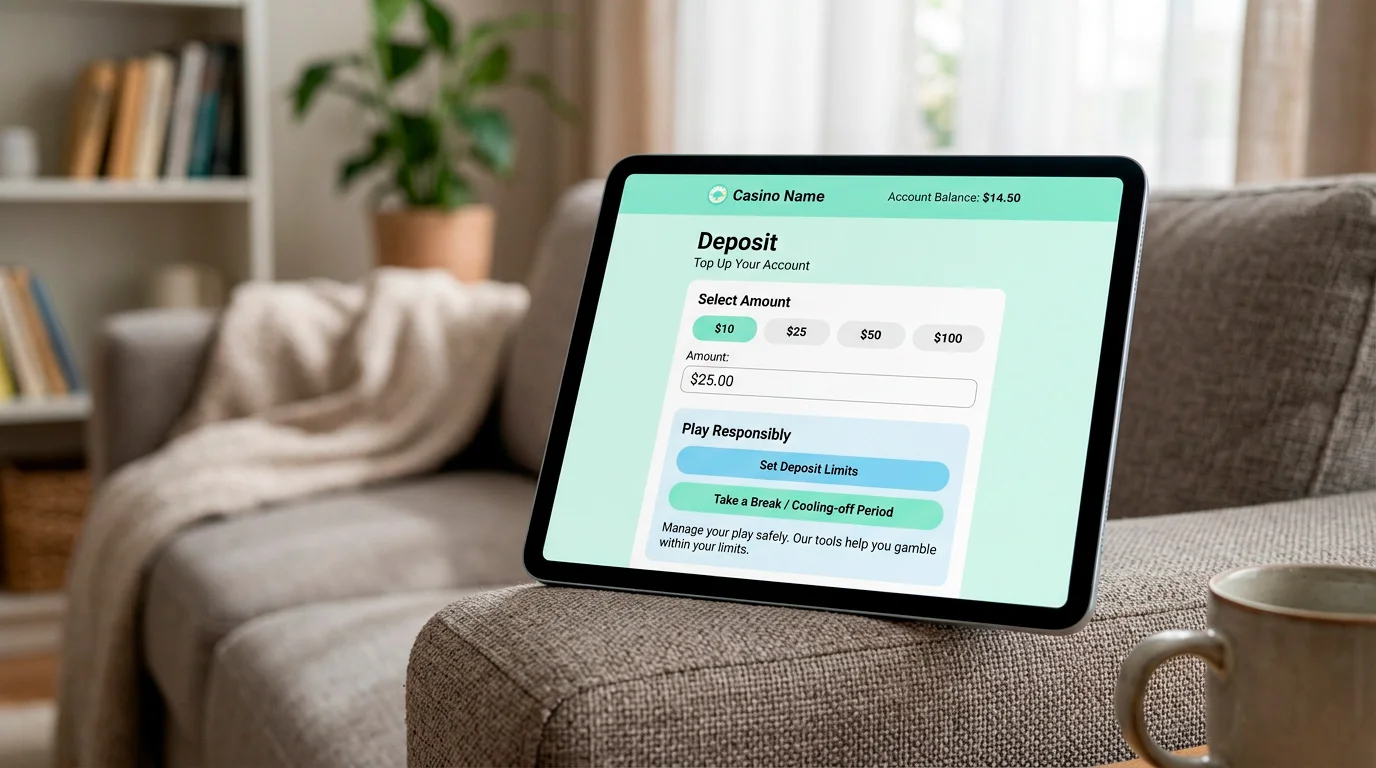
The same-method rule applies to withdrawals: you generally must withdraw to the same payment method you used to deposit. If you deposit via your Visa debit card, your withdrawals go back to that card. This is an anti-money-laundering measure, not a site-specific quirk. Knowing this upfront prevents confusion when you eventually request your first cashout.
The full picture is in our guide to UK real-money online casinos.
Game Selection: Where to Start and What to Understand First
A typical UKGC-licensed casino offers between 500 and 3,000 games. For a beginner, this catalogue is overwhelming. My advice is to start with two categories: slots and European roulette. Not because they are the “best” games — there is no such thing — but because they are the simplest to understand and the hardest to play incorrectly.
Slots require no strategy. You set a bet size, press spin, and the random number generator determines the outcome. Every spin is independent; past results have no influence on future outcomes. The key number to check is the game’s RTP — anything above 96% is standard for UK-licensed slots. The £5 per spin maximum (or £2 if you are under 25) sets the ceiling on how much you can wager per round, and autoplay is banned, meaning you control each spin individually.

European roulette has a fixed house edge of 2.7% across all bet types, making it one of the most transparent games in the casino. Whether you bet on red, on a single number, or on a column, the underlying maths is identical — only the variance differs. Outside bets (red/black, odd/even) pay close to 1:1 frequently. Inside bets (single numbers) pay 35:1 rarely. For a beginner, outside bets offer the gentlest introduction because the frequent wins — even though they are small — help you understand the rhythm of the game before you encounter extended losing streaks.
Blackjack offers the best mathematical return of any casino game (up to 99.5% RTP), but only if you play perfect basic strategy. For a complete beginner, learning basic strategy before sitting down at a table is essential — otherwise, the effective RTP drops well below what you would get from a standard slot. Live dealer blackjack adds the human element but the maths is unchanged.
Managing Your Session: Time, Budget, and Knowing When to Stop
The single best predictor of how much someone loses at an online casino is not which game they play or what RTP it carries — it is how long they play. The Remote Gaming Duty increase from 21% to 40% in April 2026 has not changed this fundamental dynamic for players: the house edge grinds your bankroll down gradually, and time is the mechanism through which it operates. A 96% RTP slot does not take 4% of your bankroll per spin. It takes 4% of every pound you wager, and the more you spin, the more you wager, the more the edge accumulates.
Set a session time limit before you start playing. Most UKGC-licensed sites offer reality check prompts — notifications that appear at intervals (30 minutes, 60 minutes) reminding you how long you have been playing and what your net position is. Enable them. They will not prevent you from continuing, but they interrupt the flow state that makes it easy to lose track of time and spending.

Walk away from a winning session. This sounds obvious, but the compulsion to continue playing when you are ahead is one of the most powerful psychological traps in gambling. A winning session is the result of variance, not skill (in RNG games), and extended play converts short-term variance into long-term house-edge convergence. The player who deposits £20, wins £60, and withdraws £40 has had a better outcome than the player who deposits £20, wins £60, continues playing, and exits with £0.
Articles
Prepared by the onlinecasinorealmoneyuk.com editorial staff.