


In February 2026, Tim Miller, Executive Director of the UK Gambling Commission, said something that made the industry sit up. Speaking at the Betting and Gaming Council’s annual general meeting, he described the Commission’s approach to cryptocurrency in gambling as “exploring the art of the possible rather than starting from a position of finding all the reasons not to innovate.” That single sentence marked a significant shift. For years, the UKGC’s position on crypto had been effectively a closed door — no licensed operator could accept cryptocurrency deposits or process crypto withdrawals. Miller’s language did not open that door, but it acknowledged the door exists and that someone is looking for the key.
The methods that are licensed here: debit card deposits.

The Current Regulatory Position: Why Crypto Is Blocked at Licensed UK Casinos
As of mid-2026, no UKGC-licensed online casino accepts cryptocurrency as a payment method for deposits or withdrawals. The restriction is not codified in a single explicit rule but emerges from the intersection of several regulatory requirements that cryptocurrency, in its current form, cannot satisfy.
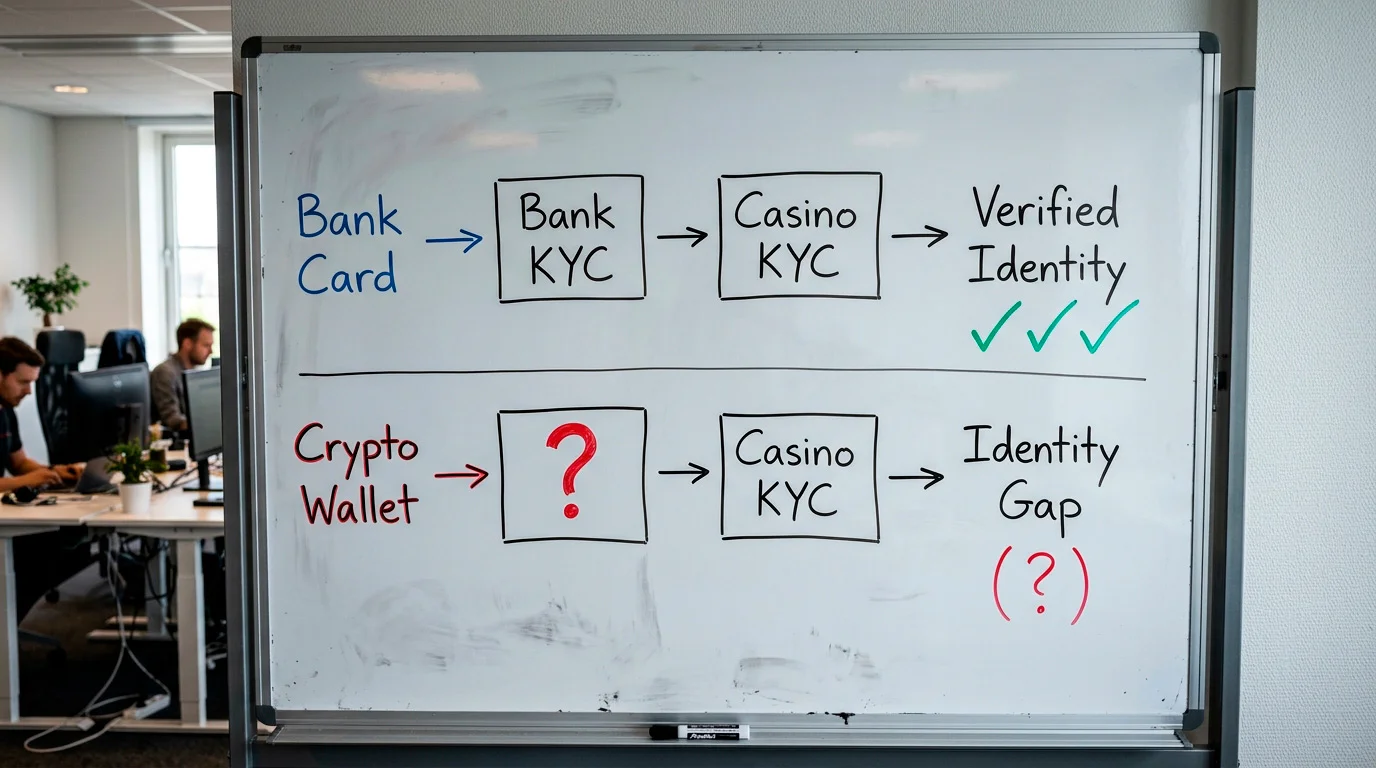
KYC and anti-money-laundering obligations require operators to verify the source of customer funds. Traditional payment methods — debit cards, bank transfers, e-wallets — are issued by regulated financial institutions that conduct their own identity verification. When you deposit via your Visa debit card, the operator can verify that the card is issued in your name by a UK-regulated bank. Cryptocurrency wallets, by contrast, are pseudonymous. A Bitcoin deposit arrives from an alphanumeric address that does not inherently link to a verified individual. The operator cannot confirm who controls the wallet or where the funds originated without additional verification steps that are not yet standardised.
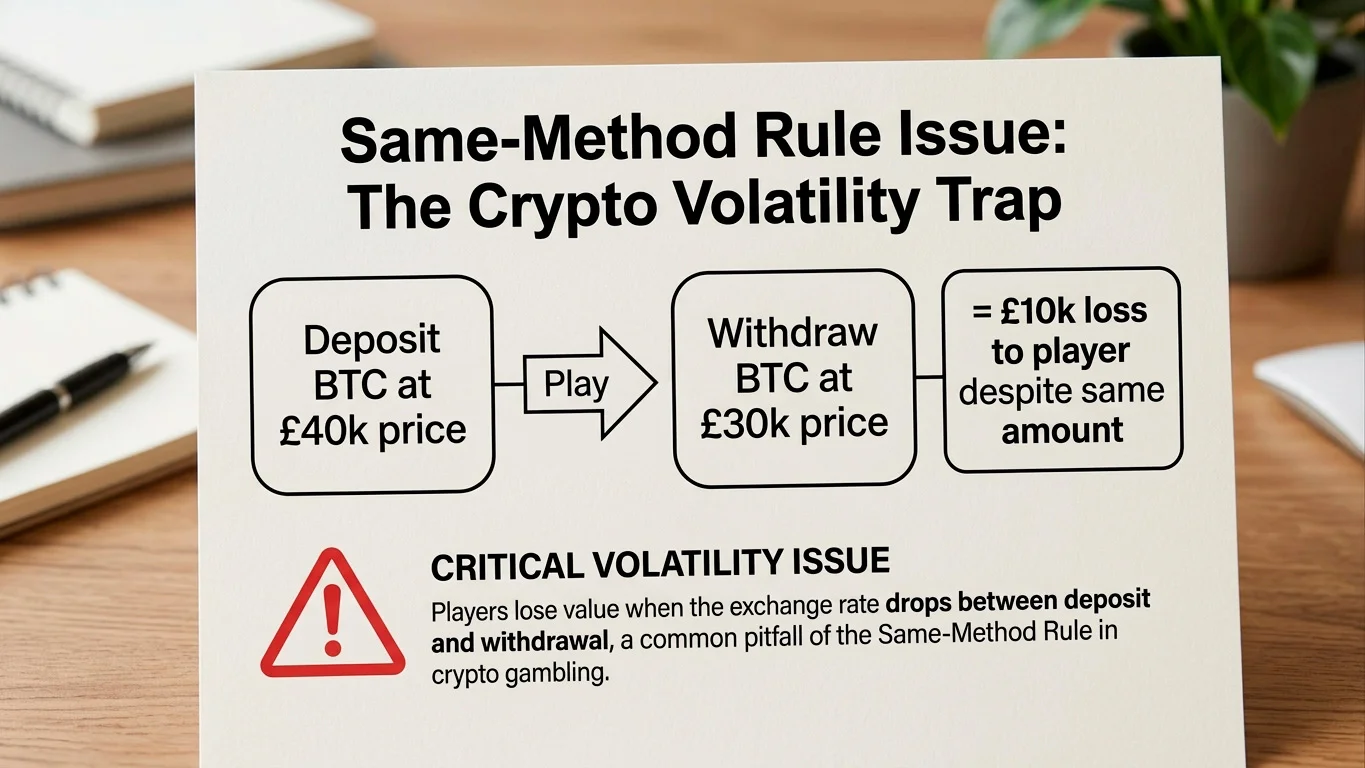
The same-method rule adds another obstacle. UKGC guidance states that withdrawals should be processed to the same method used for deposit. If a player deposits in Bitcoin, the operator would need to return winnings in Bitcoin — exposing both parties to exchange rate volatility between the time of deposit and the time of withdrawal. A player who deposits 0.01 BTC when Bitcoin trades at £40,000 (depositing £400 equivalent) and later withdraws 0.01 BTC when Bitcoin trades at £30,000 would receive £300 in purchasing power despite the operator returning the same nominal amount of cryptocurrency.
Financial risk assessments, triggered at £150 in net deposits within 30 days, require operators to assess players’ financial vulnerability. The volatility and opacity of cryptocurrency holdings make this assessment practically difficult — an operator cannot determine whether a player’s crypto deposit represents 1% or 100% of their total assets without information that cryptocurrency infrastructure does not readily provide.
Top online casinos in the UK
- x3betBonus: Welcome Pack 100% Up to £1.000 + 200 Free Spins · Payout speed: 1-3 business days
- AmunbetBonus: Join now and get 450% up to 2,700 GBP + 450 FS · Payout speed: 1-3 business days
- SpinFormulaBonus: 550% Up To £15,000 + 550 FS · Payout speed: 1-3 business days
- SlotoSportBonus: 500% up to £ 10 200+ 777 FS · Payout speed: 1-3 business days
- NightLuckBonus: Welcome Pack + 805% Up To 6400€ + 280 FS · Payout speed: 1-3 business days
- DieselwinBonus: Welcome Pack 250% up to £4000 + 200 FS · Payout speed: 1-3 business days
What Players Encounter in Practice
Despite the regulatory block at licensed UK casinos, approximately 5.8% of UK gamblers reported using a VPN to access gambling sites. Some of that VPN usage involves accessing offshore crypto-only casinos — platforms that accept Bitcoin, Ethereum, or stablecoins as their primary or only payment method. These sites are not licensed by the UKGC and operate entirely outside the UK regulatory framework.
The risks of using unlicensed crypto casinos are substantial and specific. There is no GAMSTOP integration — self-excluded players can deposit freely. There is no mandatory KYC, which means no age verification and no financial vulnerability screening. Player funds are not segregated from operating funds, so if the operator becomes insolvent, deposited cryptocurrency is unrecoverable. There is no access to UKGC-approved ADR providers, meaning disputes have no regulatory resolution mechanism. And provably fair gaming claims, while verifiable in theory, are not audited by independent testing houses in the way that UKGC-licensed games are.
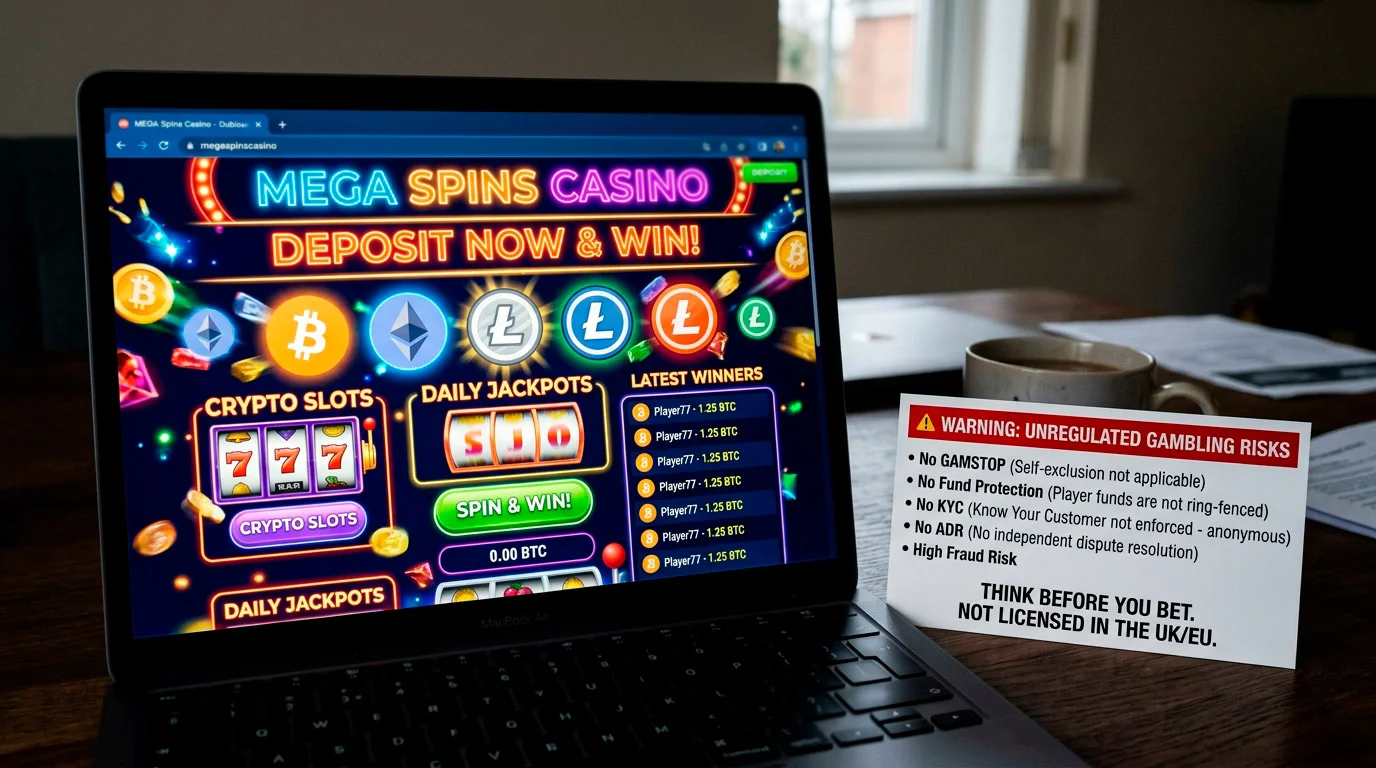
The appeal of crypto casinos — instant deposits, fast withdrawals, pseudonymous play, and sometimes higher deposit and withdrawal limits — is real, but it comes at the cost of every player protection that the UK regulatory framework provides. The growth of the black market to £16.6 billion in stakes at unlicensed operators (more than tripling from £5 billion in 2019) reflects the demand for less-regulated gambling options, and crypto platforms capture a portion of that demand. For a broader analysis of the black market and its risks, the safe online casinos guide covers UKGC enforcement actions and why unlicensed sites are dangerous.
The full picture is in our guide to UK real-money online casinos.
What Tim Miller’s Comments Signal for the Future
The UKGC’s exploration of cryptocurrency acceptance is not a commitment to legalisation. It is a recognition that blanket exclusion creates its own harms. If regulated operators cannot accept crypto, crypto-native players migrate to unregulated platforms where no protections exist. The Commission’s calculation appears to be that controlled crypto integration within the licensed market might be preferable to leaving crypto demand entirely unserved by regulated operators.
Several practical models are being discussed within industry and regulatory circles. One approach would allow operators to accept cryptocurrency deposits but immediately convert them to GBP at the point of transaction, with all subsequent account activity and withdrawals occurring in fiat currency. This would solve the exchange rate volatility problem and the same-method rule issue, though it would add conversion costs and would still require solving the KYC challenge at the deposit stage.

A second model would restrict crypto acceptance to stablecoins — cryptocurrencies pegged to fiat currencies (such as USDT pegged to the US dollar or a hypothetical GBP-pegged stablecoin). Stablecoins eliminate volatility but retain the pseudonymity challenge. A third model would require crypto deposits to originate from wallets registered with FCA-regulated cryptocurrency exchanges, which conduct their own KYC. This would create a chain of verified identity from the exchange to the gambling operator, satisfying AML requirements without requiring the operator to verify the crypto wallet independently.
None of these models has been formally proposed by the UKGC. Miller’s comments are a signal of direction, not a regulatory timetable. The Commission’s consultation process for new payment methods is lengthy — the credit card ban, by comparison, was first proposed in 2019 and took over a year to implement. Crypto integration, which involves more complex regulatory and technical challenges, is unlikely to move faster.
What This Means for UK Players Right Now
In 2026, the practical reality is binary. If you want to gamble at a UKGC-licensed casino, you use fiat currency through regulated payment methods. If you want to gamble with cryptocurrency, you are using an unlicensed platform that offers none of the protections that UK regulation provides — no stake limits, no mandatory responsible gambling tools, no fund segregation, no ADR access, and no GAMSTOP integration.
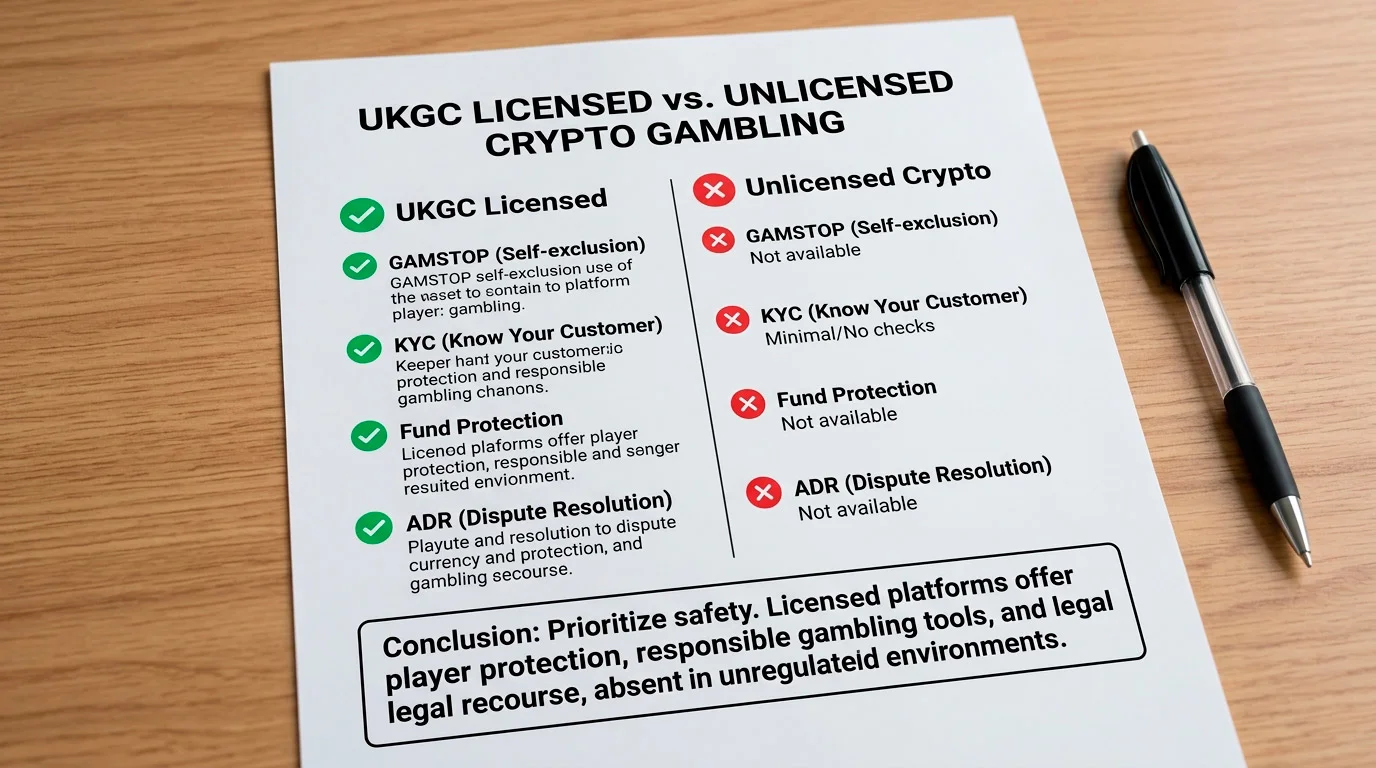
The UK’s regulatory framework, for all its friction — the KYC checks, the £150 FRA threshold, the wagering caps, the stake limits — exists because decades of evidence demonstrate that unregulated gambling produces disproportionate harm. The Commission’s openness to exploring crypto does not change the current rules. It signals that the regulator is willing to adapt the framework to accommodate new payment technology, provided the player protections embedded in that framework remain intact. Until that adaptation is complete, the choice between crypto and regulation is exactly that: a choice between two fundamentally different risk profiles.
Articles
Created by the "onlinecasinorealmoneyuk.com" editorial team.